Books › Mix Like a Producer › Background Vocals and Harmonies
Background Vocals and Harmonies in United Arab Emirates
Readers in United Arab Emirates looking for background vocals and harmonies usually want something practical, not theory. These 3 chapters of "Mix Like a Producer" go straight to the point: read the excerpts, try the challenge and decide if you want the whole book.
Background Vocals: The Secret Behind "Big" Songs · Chapter 8
Listen closely to your favorite song and try to hear something beyond the lead vocal. Almost certainly there are other voices behind it, softer ones. Those are background vocals (also called backing vocals). They are one of the big secrets of productions that sound "big." And they are misused very often.
In this chapter: Type 1: Vocals That Reinforce the Melody · The Mistake Almost Everyone Makes · Why Every Take Is Different · Other Types of Background Vocals · Recording Technique · Don't Fill Everything
The Mistake Almost Everyone Makes
Here comes the key question:
"Why don't I just copy the same recording, put it on the left, and put another copy on the right?"
Because it doesn't work. If you copy the same take, all you get is more volume: the same waveform playing three times. There is no width. It's just louder sound, and for that you don't need to duplicate anything: you compress and turn up the volume.
Real width comes from different takes.
Read the full guide to "Background Vocals: The Secret Behind "Big" Songs" →
Harmony Without Sheet Music · Chapter 9
Lots of people think harmonizing is something only trained musicians can do. It's not. With a couple of rules, you can harmonize your voice today, without reading a single note of sheet music.
In this chapter: Two Kinds of Harmony · The Golden Rule: Stay Inside the Key · Thirds and Fifths · The Intervals That Grind · Voice Leading · A Seventh Chord: The Secondary Dominant
Thirds and Fifths
A chord is built by stacking notes. The root note, a third above it, and a fifth above it. With those three notes, you have a major or minor chord.
To harmonize, pick notes from the chord that's playing at that moment and that move close to the lead voice. If the voice sings C and the chord is C major, you can harmonize with E (the third) or with G (the fifth).
A practical method, no music reading required:
- Open the Piano roll in FL Studio.
- Draw the notes the lead voice sings (just the notes; the duration doesn't matter as much).
- Put another channel on top and write notes a third or a fifth above, always inside the key.
- Listen. Adjust anything that sounds off.
Good harmony is heard with your ear. The Piano roll is just there to help you test.
Read the full guide to "Harmony Without Sheet Music" →
Counterpoint and the Pedal Tone · Chapter 10
Counterpoint sounds like a word straight out of a conservatory. But the idea is simple: each voice sings its own melody, and together they sound great.
In this chapter: What it means · The species · Passing tones · An example to make it click · How to practice it without sheet music · The pedal tone · An important reminder
Passing tones
When a supporting voice moves from one important note to another, it can travel through notes in between: the passing tones. They smooth out the movement and create a sense of flow. They don't belong to the chord, but they lead the ear naturally from one important note to the next.
Read the full guide to "Counterpoint and the Pedal Tone" →
Your challenge for today
Record three takes of the same phrase. Put one in the center, another on the left, another on the right. Then do the opposite test: duplicate a single take and pan it the same way. Compare them with headphones. You'll feel the difference.
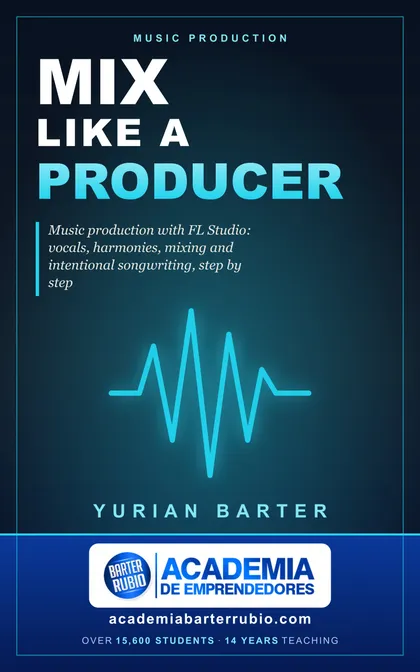
Read the whole book
"Mix Like a Producer" in PDF: 19 chapters, each with a challenge. $8.99, delivered to your email (charged in USD; your bank converts it to dirhams).
Get the PDF · $8.99Or learn it free, with a certificate
Start the free Music Production course in the Barter AI Academy app: short lessons, practice with an AI tutor and a certificate when you finish.
Start the free courseSee the free Music Production course in United Arab Emirates →
Frequently asked questions
Is there a book about background vocals and harmonies?
Yes. "Mix Like a Producer" by Yurian Barter covers it in chapters 8, 9, 10. It is available in PDF for $8.99 and arrives by email.
Can I buy it from United Arab Emirates?
Yes. You pay $8.99 USD with PayPal or a debit or credit card; your bank converts the amount to dirhams. The PDF is delivered to your email right after the payment.
Is there a free way to learn background vocals and harmonies?
Yes. The Barter AI Academy app has a free Music Production course with a certificate. The book is the deeper, step-by-step version.
More guides from "Mix Like a Producer"
Music Production Book PDF · How to Mix Vocals · Music Theory for Producers · Circle of Fifths Explained · Mixing in FL Studio · Microphone for Home Recording · Mixing Order EQ and Compression · Reverb and Delay in Mixing · Sidechain Compression Explained · De-Essing Vocals · Reference Track Mixing · Panning in Mixing · How to Finish Songs · Chord Progressions for Beginners
More books by Yurian Barter
You Are the Machine · Edit Like a Director · Move the World · Ads That Sell · Google Finds You · Sell Without Pressure · Let Them Find You