Books › Edit Like a Director › Chapter 16
📘 Edit Like a Director · Chapter 16 of 17
Clean Audio: Clarity and Stability
A practical summary of chapter 16 of "Edit Like a Director" for entrepreneurs and creators in Canada: what you will learn, an excerpt you can apply today and the closing challenge.
A viewer will forgive a mediocre image. They won't forgive bad audio.
If the sound is muddy, echoey, or jumps in volume, people close the video. And they don't come back. That's why the first step in sound design is getting a clean voice.
What this chapter covers
- The golden rule: never go past 0 decibels
- Be careful when recording
- EQ: clarity
- Dynamics: stability
- Centering
- Voices and music: sharing the space
- Clean up the mistakes
- The chapter challenge
Dynamics: stability
If your voice goes up and down in volume without control, the viewer gets tired. Compression reduces the difference between loud and soft.
A simple summary:
- Equalizer = clarity.
- Dynamics = stability.
Your challenge
Record thirty seconds of voice. Apply a low cut, a little compression, and center the audio. Listen to it before and after, with headphones, and write down what improved.
Clarity comes from the equalizer. Stability comes from dynamics. And confidence comes from both.
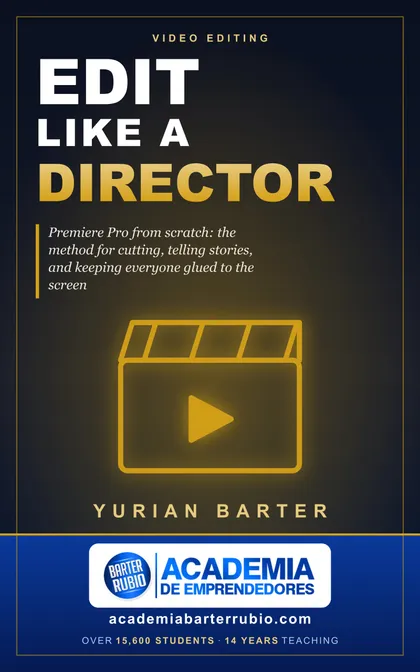
Read the whole book
"Edit Like a Director" in PDF: 17 chapters, each with a challenge. $8.99, delivered to your email (charged in USD; your bank converts it to Canadian dollars).
Get the PDF · $8.99Or learn it free, with a certificate
Start the free Video Editing and Content Creation course in the Barter AI Academy app: short lessons, practice with an AI tutor and a certificate when you finish.
Start the free courseSee the free Video Editing and Content Creation course in Canada →
Related guides in Canada
How to Clean Audio in Premiere Pro · Sound Design for Video
All chapters of "Edit Like a Director"
- A Video Is a Very Well-Told Lie
- Editing Is Not the Same as Assembling
- Shots: The Editor's Alphabet
- Where the Camera Looks From
- Compose Before You Cut
- Open Premiere Without Fear
- In Points, Out Points, and Markers: Don't Drag Everything In
- The Timeline and Its Tracks
- The Tools and Shortcuts That Make You Fast
- The Experiment That Proves Your Brain Edits
- Linear Editing and Continuity
- The Imaginary Axis and Parallel Editing
- Pacing: Calm or Euphoria
- Animate Your Video: Keyframes in Premiere
- The Technical Script: Write Before You Cut
- Clean Audio: Clarity and Stability
- Sound Design: What You Don't See, You Feel
← The Technical Script: Write Before You CutSound Design: What You Don't See, You Feel →
More books by Yurian Barter
You Are the Machine · Move the World · Mix Like a Producer · Ads That Sell · Google Finds You · Sell Without Pressure · Let Them Find You