Books › Edit Like a Director › 180 Degree Rule in Editing
180 Degree Rule in Editing in Ireland
If you are searching for 180 degree rule in editing in Ireland, this page gathers the parts of "Edit Like a Director" by Yurian Barter that deal with it directly: 3 chapters, with an excerpt from each and the challenge you can do today.
The Imaginary Axis and Parallel Editing · Chapter 12
There are mistakes the audience can't name, but they feel them. Crossing the axis is one of them.
In this chapter: The Line You Don't Cross · If You Already Shot It and Crossed the Axis · Parallel Editing · The Exercise · The Visible Cause Rule
The Line You Don't Cross
Picture two people talking face to face. Draw an imaginary line between them. That line is called the imaginary axis, or axis line.
The rule: all your cameras must stay on the same side of that line. The space where you can move the camera is a semicircle: the 180° range.
Why? Because if you shoot the first person from one side and the second person from the other side of the line, on screen they both look toward the same side, and it seems they aren't talking to each other. The conversation breaks.
Here's an example I like to tell: a woman looks to the left of the frame. Another woman, talking on the phone from somewhere else, looks to the right. Even though they're in different places, when you cut from one to the other, it feels like they're having a conversation. Looking in opposite directions, they "talk" to each other. If both looked to the left, they wouldn't.
Inside that semicircle, you can move freely: draw new lines for each shot, move closer, move farther, change the angle. What you can't do is cross to the other side.
Read the full guide to "The Imaginary Axis and Parallel Editing" →
Where the Camera Looks From · Chapter 4
Shot size answers the question "How close?" Camera angle answers a different one: where is the camera looking from? Two videos of the same character, with the same shot size, can tell completely opposite stories just because of the height of the camera.
In this chapter: The Five Angles · The Power of Angle · The Most Important Rule of This Chapter · The Exception That Proves the Rule
The Most Important Rule of This Chapter
Now comes the golden rule. Write it down, underline it, tattoo it on your arm:
What does that mean? If your first clip is an extreme wide shot, the next one can't be another extreme wide shot of the same person. The framing has to change: a medium-wide shot (plano americano), a close-up, a full shot.
Why? Because if you put two nearly identical shots together, the eye feels an uncomfortable "jump," as if the video had glitched. The cut shows, and a good cut is one you don't notice.
It's also a good idea to change the angle. If you go from one frontal shot to another that's almost the same, the cut "jumps." If you change both size and angle, the cut flows.
Read the full guide to "Where the Camera Looks From" →
Linear Editing and Continuity · Chapter 11
And to learn it, there's an exercise almost every teacher uses. We're going to do it together.
In this chapter: The Exercise: Reorder a Scene · The Rule of the Game · The Rules You Need · When Continuity Breaks · The Cutaway Shot: Your Lifesaver · Watch Out for Transitions as a Patch · Heads Up: Overwriting · Review: The Viewer Test
Review: The Viewer Test
When you finish, watch it from start to finish without pausing, the way someone who has never seen it would. Do you understand what happened? Is there any strange jump? Any shot that doesn't answer the one before it? Write it down. Fix it. Repeat.
Read the full guide to "Linear Editing and Continuity" →
Your challenge for today
Shoot two simultaneous actions, for example, someone waiting in one place and someone approaching from another. Edit by alternating: first long shots, then shorter and shorter ones. Watch how the tension rises as the shots get shorter.
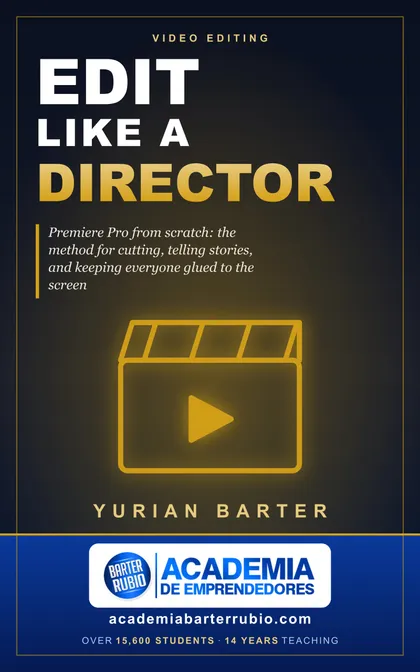
Read the whole book
"Edit Like a Director" in PDF: 17 chapters, each with a challenge. $8.99, delivered to your email (charged in USD; your bank converts it to euros).
Get the PDF · $8.99Or learn it free, with a certificate
Start the free Video Editing and Content Creation course in the Barter AI Academy app: short lessons, practice with an AI tutor and a certificate when you finish.
Start the free courseSee the free Video Editing and Content Creation course in Ireland →
Frequently asked questions
Is there a book about 180 degree rule in editing?
Yes. "Edit Like a Director" by Yurian Barter covers it in chapters 12, 4, 11. It is available in PDF for $8.99 and arrives by email.
Can I buy it from Ireland?
Yes. You pay $8.99 USD with PayPal or a debit or credit card; your bank converts the amount to euros. The PDF is delivered to your email right after the payment.
Is there a free way to learn 180 degree rule in editing?
Yes. The Barter AI Academy app has a free Video Editing and Content Creation course with a certificate. The book is the deeper, step-by-step version.
More guides from "Edit Like a Director"
Video Editing Book PDF · Premiere Pro for Beginners · Premiere Pro Shortcuts · Types of Camera Shots · Video Editing for Beginners · Continuity Editing · Pacing in Video Editing · Keyframes in Premiere Pro · How to Write a Video Script · How to Clean Audio in Premiere Pro · Sound Design for Video · Film Editing Techniques · Composition in Video · Learn Video Editing Step By Step
More books by Yurian Barter
You Are the Machine · Move the World · Mix Like a Producer · Ads That Sell · Google Finds You · Sell Without Pressure · Let Them Find You