Books › Edit Like a Director › Chapter 3
📘 Edit Like a Director · Chapter 3 of 17
Shots: The Editor's Alphabet
Reading from New Zealand? Here is chapter 3 of "Edit Like a Director" explained: the key ideas, one complete section and the challenge Yurian Barter gives at the end.
If you want to write, you learn the alphabet first. If you want to edit, you learn shots first.
This is the most important thing you'll study in this book. Because editing is putting one shot after another, and if you don't know which shot you're holding, you're cutting blind.
What this chapter covers
- Frame and composition
- From far to near
- The ones you'll use most
- A trick to remember them
- The chapter challenge
From far to near
Let's walk through them, from the farthest to the closest, using a person as the main element.
Extreme wide shot (EWS). The person is a tiny ant. You can't make out their face. There's a lot of empty space above and below, and that space is called cinematic air. It's used to show the place, the vastness, the loneliness.
Wide shot (WS). The whole person is visible, still small, and the surroundings rule. You start to see features, even if only a little.
Full shot (FS). From feet to head, with no air above or below. The whole body fills the frame.
American shot (AS). From the knees up. Where does the name come from? From old Western movies: to show the cowboy drawing his gun from his hip, they put the camera at knee height. Hence, "American."
Medium shot. From the waist up.
Close-up (CU). From the shoulder to the top of the head. It's the interview shot. A face talking.
Extreme close-up (ECU). From chin to forehead. Very intense. Hair almost never makes it into the frame here.
Detail shot (DS). A single detail: an eye, a mouth, a button, a texture. It's the one that surprises the most when you use it at just the right moment.
Your challenge
Pick someone (or yourself in front of a mirror) and record them in six different shot sizes, from the farthest to the closest. Then place them one after another in your editor, and feel how, just by changing the size, the story becomes more intimate.
The closer you put the camera, the closer the viewer is to what the character feels.
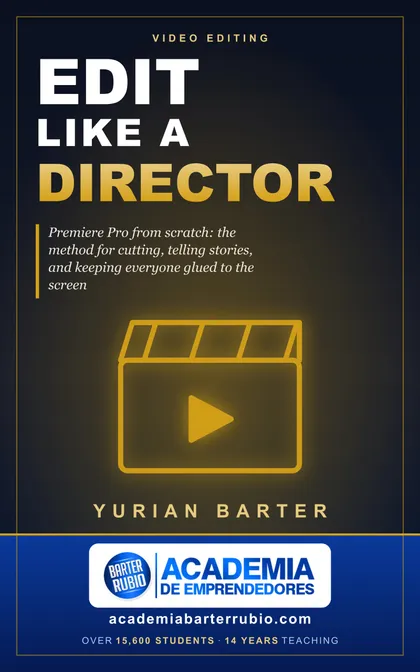
Read the whole book
"Edit Like a Director" in PDF: 17 chapters, each with a challenge. $8.99, delivered to your email (charged in USD; your bank converts it to New Zealand dollars).
Get the PDF · $8.99Or learn it free, with a certificate
Start the free Video Editing and Content Creation course in the Barter AI Academy app: short lessons, practice with an AI tutor and a certificate when you finish.
Start the free courseSee the free Video Editing and Content Creation course in New Zealand →
Related guides in New Zealand
Video Editing Book PDF · Types of Camera Shots · Composition in Video
All chapters of "Edit Like a Director"
- A Video Is a Very Well-Told Lie
- Editing Is Not the Same as Assembling
- Shots: The Editor's Alphabet
- Where the Camera Looks From
- Compose Before You Cut
- Open Premiere Without Fear
- In Points, Out Points, and Markers: Don't Drag Everything In
- The Timeline and Its Tracks
- The Tools and Shortcuts That Make You Fast
- The Experiment That Proves Your Brain Edits
- Linear Editing and Continuity
- The Imaginary Axis and Parallel Editing
- Pacing: Calm or Euphoria
- Animate Your Video: Keyframes in Premiere
- The Technical Script: Write Before You Cut
- Clean Audio: Clarity and Stability
- Sound Design: What You Don't See, You Feel
← Editing Is Not the Same as AssemblingWhere the Camera Looks From →
More books by Yurian Barter
You Are the Machine · Move the World · Mix Like a Producer · Ads That Sell · Google Finds You · Sell Without Pressure · Let Them Find You