Books › You Are the Machine › Customer Acquisition Cost Explained
Customer Acquisition Cost Explained in Philippines
Customer acquisition cost explained is one of the topics Yurian Barter covers in "You Are the Machine". Below are the 3 chapters that matter most for it, with a real excerpt from each, so you can start applying it in Philippines today.
How Much Does Each Customer Cost You? · Chapter 17
What would you think if tomorrow you discovered that your business has been selling for five years… while quietly losing money? Picture it. You open your store. The phone rings. Orders come in. Customers show up. Social media is active. Everything looks like a success. But at the end of the month you check your bank account and the money never stretches far enough. Where did it go? Most people answer: "Competition, the economy, the state of the country."
In this chapter: The Man Who Sold a Lot and Got Poorer with Every Sale · The Goal of Advertising Isn't to Sell · The Numbers You Need to Know · Invisibility Costs Too · The Free Trap
The Free Trap
And since we're talking about costs, let me ask you another question:
What's more expensive: a course, a paid tool… or five years of your life trying to learn everything for free?
Most would say the course. Because the visible price always hurts more than the invisible cost.
We live in an era when almost everything seems free: tutorials, videos, apps, templates, artificial intelligence, infinite information. And yet there have never been so many confused people, so many people starting, and so few finishing.
Free rarely costs money. It costs time. And time is the only resource you can't get back.
The Infinite Library
Imagine a library containing all of humanity's knowledge. Every book, every strategy, every formula. All free.
Millions of people walk in. They spend years reading, taking notes, saving information, bookmarking pages.
And most die without having built anything.
A young man asks an old man how it's possible that, with all the world's knowledge available, people still fail. And the old man answers:
"Because the problem was never a lack of information. It was too much information without execution."
That's the internet. That's the downloaded courses you never finish and the hundreds of saved tutorials. The entrepreneur who doesn't understand this ends up a content collector, not a builder of results.
Read the full guide to "How Much Does Each Customer Cost You?" →
Vision vs. Survival · Chapter 16
Today we're not going to talk about metrics, or clicks, or algorithms. We're going to talk about something above all of that. Something that separates those who end up in the history books from those who end up on the year's bankruptcy list: vision. And above all, the brutal resilience it takes to hold on to it until the world proves you right.
In this chapter: The iPhone Effect · Howard Schultz's Closed Doors · He Saw It First · The Dark Moment · The Coca-Cola Effect
The iPhone Effect
Go back with me to 2007.
Steve Jobs walks onto the stage and pulls a device without a keyboard out of his pocket. Many laughed. The big tech companies of the era treated it like an expensive toy. The makers of phones with keyboards said people needed physical buttons to type.
But Jobs wasn't looking at a phone. He was looking at the future in the palm of a hand.
That's the difference between having a business and having a vision:
- A business looks to sell today in order to eat tomorrow.
- A vision looks to change tomorrow so the world never goes back to the way it was.
And here comes the part they don't tell you in cheap courses: holding a vision hurts. It makes you look crazy in front of your family, in front of your friends, and sometimes in front of your own mirror.
Read the full guide to "Vision vs. Survival" →
Without Marketing, There's No Paradise · Chapter 25
Once there was a baker named Tomás. His bread was so good that the neighbors said you could smell happiness from a block away. But Tomás had a problem: nobody beyond his neighborhood knew him. Every morning he got up at four, kneaded with love, baked with passion. And every night he wondered why he wasn't selling more. One day a new customer walked in and said: "Your bread is the best I've ever tasted. Why don't you advertise on social media?"
In this chapter: Humility Isn't Invisibility · The Day of Zero Sales · Chasing or Attracting · First, Capture Attention
First, Capture Attention
Have you ever walked into a store because of a huge sign saying "50% OFF"?
You weren't planning to buy anything. But you see the red sign and something happens inside your brain: your eyes widen, your pace slows, and without realizing it you're already inside.
And many times you discover that the discounted items are few: sizes nobody wears, colors nobody buys. But it's already too late, because the goal was never to sell you that item. The goal was to get you to walk in.
Once inside you walk around, see other products, try something on, talk to a salesperson… and the chances of buying go up.
The Digital "50% Off"
Most entrepreneurs try to sell head-on: "Buy my product," "Hire my service." And nobody pays attention.
The right question is: how do I get them to walk into my store first, even if my store is digital?
On the internet, the equivalent of the sign is free value: a guide, an open class, a diagnosis, a sample. Not to give everything away, but so the person steps into your ecosystem.
And on your social media, swap the ad for curiosity:
Great businesses don't sell first. First they capture attention, then they build trust, and finally they sell.
Read the full guide to "Without Marketing, There's No Paradise" →
Your challenge for today
- Calculate your CAC. Add up everything you spent last month to get customers (advertising, design, commissions, time) and divide it by the new customers who came in.
- Calculate your profit per sale. Price minus all the costs of that sale.
- Compare them. If the CAC is higher than the profit, look at how many times a customer buys again. Does that make up for it?
- Your "free" list. Write down three tasks you do yourself just "to save money" and estimate how many hours a month they cost you. What are those hours worth?
---
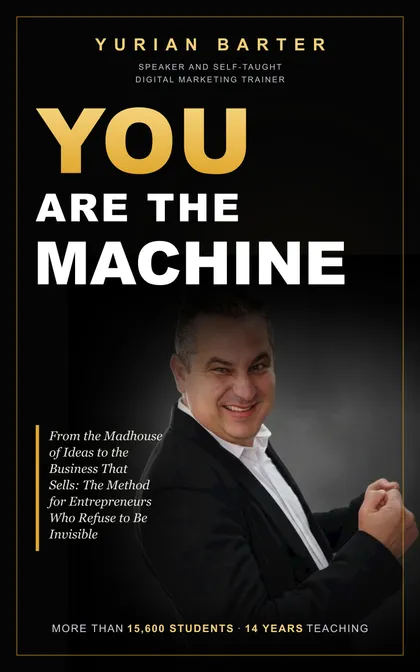
Read the whole book
"You Are the Machine" in PDF: 32 chapters, each with a challenge. $8.99, delivered to your email (charged in USD; your bank converts it to pesos).
Get the PDF · $8.99Or learn it free, with a certificate
Start the free Digital Marketing course in the Barter AI Academy app: short lessons, practice with an AI tutor and a certificate when you finish.
Start the free courseFrequently asked questions
Is there a book about customer acquisition cost explained?
Yes. "You Are the Machine" by Yurian Barter covers it in chapters 17, 16, 25. It is available in PDF for $8.99 and arrives by email.
Can I buy it from Philippines?
Yes. You pay $8.99 USD with PayPal or a debit or credit card; your bank converts the amount to pesos. The PDF is delivered to your email right after the payment.
Is there a free way to learn customer acquisition cost explained?
Yes. The Barter AI Academy app has a free Digital Marketing course with a certificate. The book is the deeper, step-by-step version.
More guides from "You Are the Machine"
Business Mindset Book · Entrepreneur Book PDF · Book for Small Business Owners · How to Start Over in Business · Fear of Rejection in Sales · How to Turn an Idea Into a Business · Referral Marketing for Small Business · Personal Brand for Entrepreneurs · How to Sell on WhatsApp · Psychology of Selling · How to Lose the Fear of Public Speaking · Discipline for Entrepreneurs · Marketing Book for Beginners · Motivational Business Book
More books by Yurian Barter
Edit Like a Director · Move the World · Mix Like a Producer · Ads That Sell · Google Finds You · Sell Without Pressure · Let Them Find You