Books › Mix Like a Producer › How to Mix Vocals
How to Mix Vocals in United States
Readers in United States looking for how to mix vocals usually want something practical, not theory. These 3 chapters of "Mix Like a Producer" go straight to the point: read the excerpts, try the challenge and decide if you want the whole book.
The Lead Vocal Rules · Chapter 7
A song has a lot going on: drums, bass, chords, synths, effects. But one element rules: the lead vocal. It carries the melody and the lyrics. It's what the listener hums on the way out the door. That's why the mix is built around it.
In this chapter: Why the vocal gets priority · What you do to a lead vocal · Why compressing helps · Before processing: clean up
Why the vocal gets priority
Think about a conversation in a restaurant. If someone speaks softly and the other tables are shouting, you can't understand them. A song works the same way: if the instruments cover the vocal, the song loses its message.
So before you think about effects, ask yourself one question: can I understand what they're saying? If the answer is no, that's where your work begins.
Read the full guide to "The Lead Vocal Rules" →
Order Matters: Volume, Compression, EQ, Effects · Chapter 12
When you start mixing, you have so many knobs within reach that you don't know where to begin. I'm going to give you an order. It works.
In this chapter: Step 1: Volume · Step 2: Compress · Step 3: EQ · Step 4: Space effects · The gold-standard test: compare without effects · An exercise for your ears · The "endless tweaking" trap
Step 2: Compress
Once the overall volume is right, compress. You already know why: it stabilizes. The loud peaks come down, the quiet parts come up, and the vocal sits more consistently.
Here's one way to see it: before compressing, your vocal swings wildly on the meter. After, it moves within a small range. That's what you're after.
Read the full guide to "Order Matters: Volume, Compression, EQ, Effects" →
Esses and Peak Control · Chapter 16
Have you ever heard a voice that drills into your ear every time it says an "s"? That's called sibilance. And it's one of the things that gives away a badly mixed voice.
In this chapter: Why It Happens · How to Spot Them · How to Control Them · The Common Mistake · The Key Test · See the Difference · Other Problem Zones · And the Gain
How to Control Them
There are several ways:
1. A frequency-based compression band. Some equalizers and multiband compressors let you treat just one zone of the spectrum. You place a band on the frequency of the esses and turn on its compression (the threshold). When the esses cross that threshold, they get compressed; the rest of the voice stays untouched.
2. A de-esser. It's a plugin built for exactly this. You set the frequency, pull it down a little, and it works.
3. By hand. If you don't have a plugin, you can lower the volume of each "s" directly on the audio clip, with a small automation, or by cutting it out and lowering the volume of that little piece.
Read the full guide to "Esses and Peak Control" →
Your challenge for today
Record a vocal line (with your phone, if that's all you have). Import it into FL Studio, even out the volumes of the parts, and add a compressor and an EQ. Listen to the original version and the processed one. Is it easier to understand? Write down what you liked about each one.
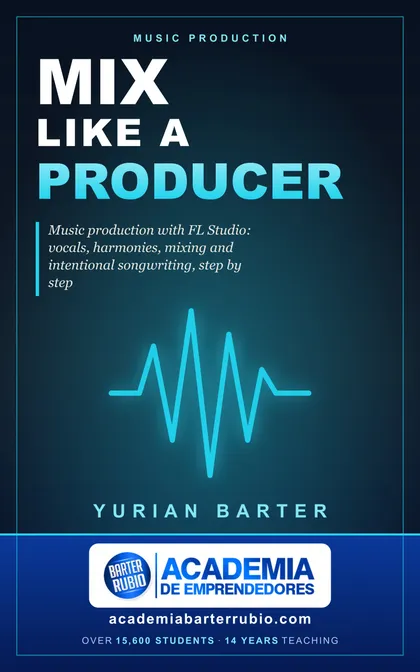
Read the whole book
"Mix Like a Producer" in PDF: 19 chapters, each with a challenge. $8.99, delivered to your email.
Get the PDF · $8.99Or learn it free, with a certificate
Start the free Music Production course in the Barter AI Academy app: short lessons, practice with an AI tutor and a certificate when you finish.
Start the free courseFrequently asked questions
Is there a book about how to mix vocals?
Yes. "Mix Like a Producer" by Yurian Barter covers it in chapters 7, 12, 16. It is available in PDF for $8.99 and arrives by email.
Can I buy it from United States?
Yes. You pay $8.99 USD with PayPal or a debit or credit card. The PDF is delivered to your email right after the payment.
Is there a free way to learn how to mix vocals?
Yes. The Barter AI Academy app has a free Music Production course with a certificate. The book is the deeper, step-by-step version.
More guides from "Mix Like a Producer"
Music Production Book PDF · Music Theory for Producers · Circle of Fifths Explained · Mixing in FL Studio · Microphone for Home Recording · Background Vocals and Harmonies · Mixing Order EQ and Compression · Reverb and Delay in Mixing · Sidechain Compression Explained · De-Essing Vocals · Reference Track Mixing · Panning in Mixing · How to Finish Songs · Chord Progressions for Beginners
More books by Yurian Barter
You Are the Machine · Edit Like a Director · Move the World · Ads That Sell · Google Finds You · Sell Without Pressure · Let Them Find You