Books › Mix Like a Producer › How to Finish Songs
How to Finish Songs in South Africa
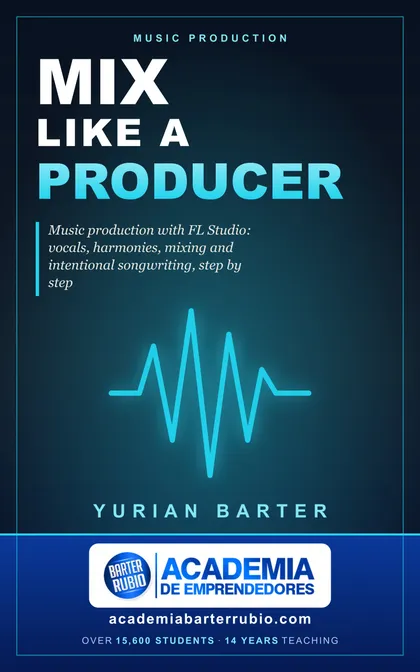
How to finish songs is one of the topics Yurian Barter covers in "Mix Like a Producer". Below are the 3 chapters that matter most for it, with a real excerpt from each, so you can start applying it in South Africa today.
Your Method for Finishing Songs · Chapter 19
We're closing the book with the hardest part: finishing. You have the knowledge. What's missing is the habit.
In this chapter: Before You Start a Project · The Ten-Step Method · Listen in Other Places · A Better Version, Not a Perfect Version · What Nobody Tells You
A Better Version, Not a Perfect Version
Every song reaches a point where it's good enough. More tweaks might improve it by 2%, or make it worse. A good producer learns to recognize that moment.
- Save a copy with the date ("mix_v3").
- Rest.
- Listen to it again the next day.
- Make only small, decisive adjustments.
Read the full guide to "Your Method for Finishing Songs" →
Tension and Resolution: The Grammar of a Song · Chapter 17
Some songs, without you knowing why, give you a knot in your stomach and then a rush of relief. That's not magic. It's tension and resolution, and it's the foundation of almost all music.
In this chapter: The Idea · A Classroom Example · Surprise Little by Little · Automation: Your Ally · Know Which Chords You're Using · Two Songs, Two Keys: Danger
Automation: Your Ally
A classic mistake: setting everything to a fixed volume from the start, with no movement. "Everything very flat." Fix it with automation:
- A pad that starts at minimum volume and grows.
- A filter that opens little by little, letting more high frequencies through.
- A reverb that increases at the end of a section.
In FL Studio you can automate almost any knob: right-click it and choose "Create automation clip." The curve is drawn in the Playlist.
Read the full guide to "Tension and Resolution: The Grammar of a Song" →
The Reference Mix · Chapter 14
There's one skill that separates the person who mixes "and hopes for the best" from the one who mixes with purpose: working with a reference.
In this chapter: What it is · How to use it · What to compare · A very valuable exercise: recreate a section · A reference, not a tyrant
What it is
A reference mix is a finished, professional song that sounds the way you'd like yours to sound. And you use it as a yardstick.
Not to copy it. To know where you want to end up.
Read the full guide to "The Reference Mix" →
Your challenge for today
Pick a song of yours (or the vocal of one you like). Apply the ten steps. Export. Compare it to your reference. Listen to it on four devices. Write a list of three things you'd improve in the next one. And start the next one.
Read the whole book
"Mix Like a Producer" in PDF: 19 chapters, each with a challenge. $8.99, delivered to your email (charged in USD; your bank converts it to rand).
Get the PDF · $8.99Or learn it free, with a certificate
Start the free Music Production course in the Barter AI Academy app: short lessons, practice with an AI tutor and a certificate when you finish.
Start the free courseFrequently asked questions
Is there a book about how to finish songs?
Yes. "Mix Like a Producer" by Yurian Barter covers it in chapters 19, 17, 14. It is available in PDF for $8.99 and arrives by email.
Can I buy it from South Africa?
Yes. You pay $8.99 USD with PayPal or a debit or credit card; your bank converts the amount to rand. The PDF is delivered to your email right after the payment.
Is there a free way to learn how to finish songs?
Yes. The Barter AI Academy app has a free Music Production course with a certificate. The book is the deeper, step-by-step version.
More guides from "Mix Like a Producer"
Music Production Book PDF · How to Mix Vocals · Music Theory for Producers · Circle of Fifths Explained · Mixing in FL Studio · Microphone for Home Recording · Background Vocals and Harmonies · Mixing Order EQ and Compression · Reverb and Delay in Mixing · Sidechain Compression Explained · De-Essing Vocals · Reference Track Mixing · Panning in Mixing · Chord Progressions for Beginners
More books by Yurian Barter
You Are the Machine · Edit Like a Director · Move the World · Ads That Sell · Google Finds You · Sell Without Pressure · Let Them Find You