Books › Edit Like a Director › Composition in Video
Composition in Video in Canada
Readers in Canada looking for composition in video usually want something practical, not theory. These 3 chapters of "Edit Like a Director" go straight to the point: read the excerpts, try the challenge and decide if you want the whole book.
Compose Before You Cut · Chapter 5
You won't always edit alone. Sometimes you'll have to shoot, or direct someone who does. And an editor who knows how to compose saves himself many hours of work, because he receives beautiful footage. These rules work just as well for photography and for video, because they're almost the same thing: one moves, the other doesn't.
In this chapter: The Rule of Thirds · The Look-Room Rule · The Golden Ratio · How to Use This When Editing
The Golden Ratio
Here composition becomes almost mathematical. The idea: divide the frame into two unequal zones, so that one serves one function and the other serves another.
- In one zone goes the subject.
- In the other goes what the subject looks at or does.
A man on one side, his computer on the other. A little girl on the left and the balloon she's chasing on the right. The image tells a mini story in a single frame.
Read the full guide to "Compose Before You Cut" →
Where the Camera Looks From · Chapter 4
Shot size answers the question "How close?" Camera angle answers a different one: where is the camera looking from? Two videos of the same character, with the same shot size, can tell completely opposite stories just because of the height of the camera.
In this chapter: The Five Angles · The Power of Angle · The Most Important Rule of This Chapter · The Exception That Proves the Rule
The Exception That Proves the Rule
There are montages where you can repeat wide shots: when there's no main character. For example, a geographic montage of landscapes: mountain, river, city, sky. There's no one to "follow" there, and several wide shots in a row work.
But as soon as a person is the star of the scene and you want continuity, the rule applies.
Read the full guide to "Where the Camera Looks From" →
Shots: The Editor's Alphabet · Chapter 3
If you want to write, you learn the alphabet first. If you want to edit, you learn shots first. This is the most important thing you'll study in this book. Because editing is putting one shot after another, and if you don't know which shot you're holding, you're cutting blind.
In this chapter: Frame and composition · From far to near · The ones you'll use most · A trick to remember them
Frame and composition
Two words that sound the same and aren't.
- Frame: the rectangle. The limits of your screen. A vertical phone has one frame; a laptop, a tablet or a movie screen has another.
- Composition: everything inside that rectangle.
And every composition always has a main element: the thing that stands out, the thing your eye looks for first. A person. An object. A face.
Shot types are defined by how far or how close that main element is to the edge of the frame.
Read the full guide to "Shots: The Editor's Alphabet" →
Your challenge for today
Turn on your phone's grid and take three photos of a person: one with the face centered, one with the face on a third looking toward the open space, and one with the face on a third looking toward the edge. See which one looks most natural. The answer is almost always the second.
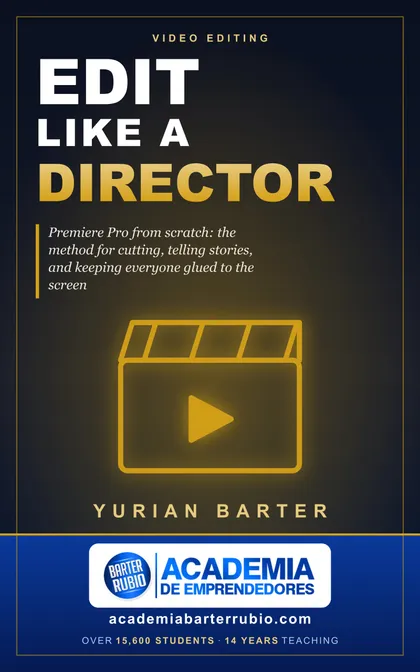
Read the whole book
"Edit Like a Director" in PDF: 17 chapters, each with a challenge. $8.99, delivered to your email (charged in USD; your bank converts it to Canadian dollars).
Get the PDF · $8.99Or learn it free, with a certificate
Start the free Video Editing and Content Creation course in the Barter AI Academy app: short lessons, practice with an AI tutor and a certificate when you finish.
Start the free courseSee the free Video Editing and Content Creation course in Canada →
Frequently asked questions
Is there a book about composition in video?
Yes. "Edit Like a Director" by Yurian Barter covers it in chapters 5, 4, 3. It is available in PDF for $8.99 and arrives by email.
Can I buy it from Canada?
Yes. You pay $8.99 USD with PayPal or a debit or credit card; your bank converts the amount to Canadian dollars. The PDF is delivered to your email right after the payment.
Is there a free way to learn composition in video?
Yes. The Barter AI Academy app has a free Video Editing and Content Creation course with a certificate. The book is the deeper, step-by-step version.
More guides from "Edit Like a Director"
Video Editing Book PDF · Premiere Pro for Beginners · Premiere Pro Shortcuts · Types of Camera Shots · Video Editing for Beginners · Continuity Editing · Pacing in Video Editing · Keyframes in Premiere Pro · How to Write a Video Script · How to Clean Audio in Premiere Pro · Sound Design for Video · 180 Degree Rule in Editing · Film Editing Techniques · Learn Video Editing Step By Step
More books by Yurian Barter
You Are the Machine · Move the World · Mix Like a Producer · Ads That Sell · Google Finds You · Sell Without Pressure · Let Them Find You