Books › Edit Like a Director › How to Write a Video Script
How to Write a Video Script in India
Readers in India looking for how to write a video script usually want something practical, not theory. These 3 chapters of "Edit Like a Director" go straight to the point: read the excerpts, try the challenge and decide if you want the whole book.
The Technical Script: Write Before You Cut · Chapter 15
Directors don't improvise in the editing room. They show up with a map. That map is called a technical script, and it's the document that turns an idea into concrete shots. With it, you know what to shoot, what to cut, and what's missing.
In this chapter: What a technical script includes · Shot abbreviations · One line per shot · Consistent format · Proofread your text · The script in the editing room
Proofread your text
On-screen titles, credits, and subtitles get read. One forgotten accent mark or a misspelled word costs an entire video its credibility. Read it out loud, and better yet, have someone else read it.
Read the full guide to "The Technical Script: Write Before You Cut" →
A Video Is a Very Well-Told Lie · Chapter 1
Look at your phone screen. What you see moving isn't moving. It's a lie. A beautiful, useful, very well-organized lie, but a lie. What's actually there are photographs, one after another, so fast that your brain can't separate them and decides something is moving. And until you understand this, you won't edit well. Because editing is deciding which photographs other people see, in what order, and for how long.
In this chapter: The Story of the Horse · Photograph and Frame: The Same Thing, a Different Place · The Ladder: Frame, Shot, Scene, Sequence · Why Cinema Is the "Seventh Art"
Why Cinema Is the "Seventh Art"
It's not a pompous title. It's called that because audiovisual work does something almost no other craft manages: it conveys feelings through what you see and what you hear. An image, a piece of music, a silence, a cut at exactly the right moment. And the person watching cries, laughs, or gets scared.
That's what you're going to learn to do. Not to "put clips one after another." To make the person watching feel something.
Read the full guide to "A Video Is a Very Well-Told Lie" →
Pacing: Calm or Euphoria · Chapter 13
I'm going to ask you a question that will change the way you watch shows and movies: Why do you feel calm in some scenes and adrenaline in others, when in both of them people are just talking and walking? The answer is in the editing rhythm.
In this chapter: Slow editing · Fast editing · An example to feel it · Color and emotions · Sound · An audio mistake that ruins videos
Slow editing
In slow editing, the shots are long. There are few cuts. The image gets room to breathe.
But watch out: a long shot is not an empty shot. A good long shot has lots of movement inside the frame: things happen within it, even if the camera doesn't cut. A person walking down a hallway while another appears in the background. A conversation that slowly gets tense.
What does it convey? Calm. It can also convey a clear message, with no rush, that the viewer takes in relaxed. No alert, no urgency.
The risk: if there's nothing inside the shot, all it conveys is boredom. That's why stretching your shots isn't enough: you have to fill them with intention.
The music has to go along with it: something soft and atmospheric, with the sound of a place (rain, a distant city, wind). Slow editing with very energetic music is counterproductive: your eye says one thing and your ear says another.
Read the full guide to "Pacing: Calm or Euphoria" →
Your challenge for today
Write the technical script for a thirty-second scene with five shots. Use abbreviations. Ask someone to read it and tell you what they picture. If they picture the same thing you do, it's well written.
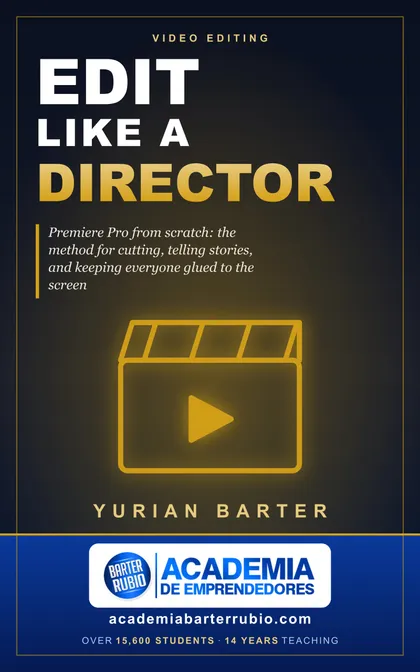
Read the whole book
"Edit Like a Director" in PDF: 17 chapters, each with a challenge. $8.99, delivered to your email (charged in USD; your bank converts it to rupees).
Get the PDF · $8.99Or learn it free, with a certificate
Start the free Video Editing and Content Creation course in the Barter AI Academy app: short lessons, practice with an AI tutor and a certificate when you finish.
Start the free courseSee the free Video Editing and Content Creation course in India →
Frequently asked questions
Is there a book about how to write a video script?
Yes. "Edit Like a Director" by Yurian Barter covers it in chapters 15, 1, 13. It is available in PDF for $8.99 and arrives by email.
Can I buy it from India?
Yes. You pay $8.99 USD with PayPal or a debit or credit card; your bank converts the amount to rupees. The PDF is delivered to your email right after the payment.
Is there a free way to learn how to write a video script?
Yes. The Barter AI Academy app has a free Video Editing and Content Creation course with a certificate. The book is the deeper, step-by-step version.
More guides from "Edit Like a Director"
Video Editing Book PDF · Premiere Pro for Beginners · Premiere Pro Shortcuts · Types of Camera Shots · Video Editing for Beginners · Continuity Editing · Pacing in Video Editing · Keyframes in Premiere Pro · How to Clean Audio in Premiere Pro · Sound Design for Video · 180 Degree Rule in Editing · Film Editing Techniques · Composition in Video · Learn Video Editing Step By Step
More books by Yurian Barter
You Are the Machine · Move the World · Mix Like a Producer · Ads That Sell · Google Finds You · Sell Without Pressure · Let Them Find You