Books › Edit Like a Director › Video Editing Book PDF
Video Editing Book PDF
Readers in India looking for video editing book PDF usually want something practical, not theory. These 3 chapters of "Edit Like a Director" go straight to the point: read the excerpts, try the challenge and decide if you want the whole book.
A Video Is a Very Well-Told Lie · Chapter 1
Look at your phone screen. What you see moving isn't moving. It's a lie. A beautiful, useful, very well-organized lie, but a lie. What's actually there are photographs, one after another, so fast that your brain can't separate them and decides something is moving. And until you understand this, you won't edit well. Because editing is deciding which photographs other people see, in what order, and for how long.
In this chapter: The Story of the Horse · Photograph and Frame: The Same Thing, a Different Place · The Ladder: Frame, Shot, Scene, Sequence · Why Cinema Is the "Seventh Art"
The Ladder: Frame, Shot, Scene, Sequence
Learn this ladder by heart. It will serve you for life:
- Frame: the smallest unit. One image.
- Shot: a group of frames with no cuts. Whatever the camera records from the moment you hit record until you stop.
- Scene: several shots that tell something happening in the same place and at the same time.
- Sequence: several scenes. It's also the name of the container you work in inside Premiere Pro.
If your video shows a room during the day, and then the same room at night, you've already changed scenes. The time changed.
Read the full guide to "A Video Is a Very Well-Told Lie" →
Editing Is Not the Same as Assembling · Chapter 2
There's a question I ask on the first day of class, and almost nobody answers it right: "What's the difference between editing and assembling?" Almost everyone says, "It's the same thing." And almost everyone is wrong.
In this chapter: Editing: the carpenter's job · Assembling: the storyteller's job · The same footage, two different stories · Edit first, then assemble
Edit first, then assemble
The work order I recommend is this:
- Watch all the footage. Without touching anything. See what you have.
- Edit. Select what works and let go, without regret, of what doesn't.
- Assemble. Decide the order, the rhythm, the kind of story.
- Polish. Music, sound, text, color, animation.
And one golden rule: if you don't know what you want the person watching to feel, don't cut yet. Ask yourself: Do I want them to be moved? To laugh? To be left in suspense? Once you have that answer, cutting gets a lot easier.
Read the full guide to "Editing Is Not the Same as Assembling" →
Shots: The Editor's Alphabet · Chapter 3
If you want to write, you learn the alphabet first. If you want to edit, you learn shots first. This is the most important thing you'll study in this book. Because editing is putting one shot after another, and if you don't know which shot you're holding, you're cutting blind.
In this chapter: Frame and composition · From far to near · The ones you'll use most · A trick to remember them
Frame and composition
Two words that sound the same and aren't.
- Frame: the rectangle. The limits of your screen. A vertical phone has one frame; a laptop, a tablet or a movie screen has another.
- Composition: everything inside that rectangle.
And every composition always has a main element: the thing that stands out, the thing your eye looks for first. A person. An object. A face.
Shot types are defined by how far or how close that main element is to the edge of the frame.
Read the full guide to "Shots: The Editor's Alphabet" →
Your challenge for today
Record three ten-second videos with your phone. A place you know, an object, a person (with their permission). Then watch them paused, frame by frame if your player allows it. Stop on any random frame and look at how the image appears when it stands still. That's the secret: nothing is really moving.
Read the whole book
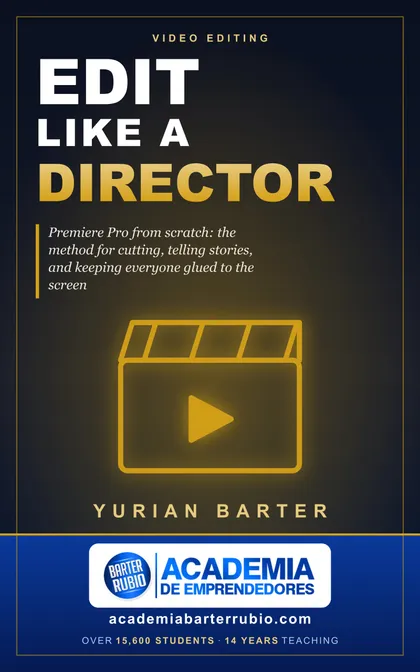
"Edit Like a Director" in PDF: 17 chapters, each with a challenge. $8.99, delivered to your email (charged in USD; your bank converts it to rupees).
Get the PDF · $8.99Or learn it free, with a certificate
Start the free Video Editing and Content Creation course in the Barter AI Academy app: short lessons, practice with an AI tutor and a certificate when you finish.
Start the free courseSee the free Video Editing and Content Creation course in India →
Frequently asked questions
Is there a book about video editing book PDF?
Yes. "Edit Like a Director" by Yurian Barter covers it in chapters 1, 2, 3. It is available in PDF for $8.99 and arrives by email.
Can I buy it from India?
Yes. You pay $8.99 USD with PayPal or a debit or credit card; your bank converts the amount to rupees. The PDF is delivered to your email right after the payment.
Is there a free way to learn video editing book PDF?
Yes. The Barter AI Academy app has a free Video Editing and Content Creation course with a certificate. The book is the deeper, step-by-step version.
More guides from "Edit Like a Director"
Premiere Pro for Beginners · Premiere Pro Shortcuts · Types of Camera Shots · Video Editing for Beginners · Continuity Editing · Pacing in Video Editing · Keyframes in Premiere Pro · How to Write a Video Script · How to Clean Audio in Premiere Pro · Sound Design for Video · 180 Degree Rule in Editing · Film Editing Techniques · Composition in Video · Learn Video Editing Step By Step
More books by Yurian Barter
You Are the Machine · Move the World · Mix Like a Producer · Ads That Sell · Google Finds You · Sell Without Pressure · Let Them Find You