Books › Google Finds You › FAQ Schema and People Also Ask
FAQ Schema and People Also Ask in United States
FAQ schema and people also ask is one of the topics Yurian Barter covers in "Google Finds You". Below are the 3 chapters that matter most for it, with a real excerpt from each, so you can start applying it in United States today.
Frequently Asked Questions: People Also Ask · Chapter 7
When you search for something on Google, sometimes a block appears that says "People also ask": expandable questions with their answers. That space is valuable.
In this chapter: Why It Works · How to Find the Questions · How to Answer · Where to Put Them · Markup · Ask for It Like This
Why It Works
People search by asking questions: "how long does it take...?", "what does it include...?", "how can I...?" If your page answers them well, you have a chance to appear. In my experience, being present in those blocks has noticeably increased visits; I have observed improvements of between 15 and 30%, though it is my experience, not a guarantee, and it depends on each site.
Read the full guide to "Frequently Asked Questions: People Also Ask" →
Structured Data: Speaking Google's Language · Chapter 6
When you look at a web page, you see colors, text and images. Google also reads the code. And there you can leave organized information so it understands you better.
In this chapter: What Structured Data Is · Why You Can Tell · The Most Useful Types · Golden Rules · How to Do It with AI
Why You Can Tell
You may have seen results on Google with stars, images of accommodations, lists of courses or expandable questions. Many of those formats depend on well-placed structured data.
Read the full guide to "Structured Data: Speaking Google's Language" →
Title, Description and H1: What Google Reads First · Chapter 3
Before reading your whole page, Google looks at three things. If you do them well, half the work is done.
In this chapter: 1. Title · 2. Meta Description · 3. H1 · The Rule: Don't Let Them Clash · One Per Page · Order of Importance in the Text · What to Ask the AI
3. H1
It is the main heading inside the page: the big headline the visitor sees. There should be only one per page and it should contain your keyword. Example of a home-page structure for an agency:
Read the full guide to "Title, Description and H1: What Google Reads First" →
Your challenge for today
Write down the five questions you are asked most. Draft them with brief answers. Place them on your home page.
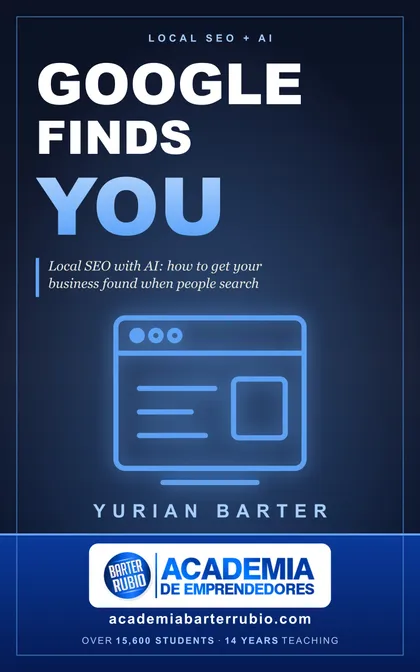
Read the whole book
"Google Finds You" in PDF: 17 chapters, each with a challenge. $8.99, delivered to your email.
Get the PDF · $8.99Or learn it free, with a certificate
Start the free Digital Marketing course in the Barter AI Academy app: short lessons, practice with an AI tutor and a certificate when you finish.
Start the free courseFrequently asked questions
Is there a book about FAQ schema and people also ask?
Yes. "Google Finds You" by Yurian Barter covers it in chapters 7, 6, 3. It is available in PDF for $8.99 and arrives by email.
Can I buy it from United States?
Yes. You pay $8.99 USD with PayPal or a debit or credit card. The PDF is delivered to your email right after the payment.
Is there a free way to learn FAQ schema and people also ask?
Yes. The Barter AI Academy app has a free Digital Marketing course with a certificate. The book is the deeper, step-by-step version.
More guides from "Google Finds You"
Local SEO Book PDF · Local SEO for Small Business · Google Business Profile Optimization · How to Rank on Google Maps · SEO with AI · Generative Engine Optimization · Structured Data for Local Business · Title Tag and Meta Description · City Landing Pages for SEO · Website Speed for SEO · Google Reviews Strategy · Google Ads vs SEO · How to Get Recommended By ChatGPT · SEO for Web Designers
More books by Yurian Barter
You Are the Machine · Edit Like a Director · Move the World · Mix Like a Producer · Ads That Sell · Sell Without Pressure · Let Them Find You