Books › Google Finds You › Structured Data for Local Business
Structured Data for Local Business in United States
Readers in United States looking for structured data for local business usually want something practical, not theory. These 3 chapters of "Google Finds You" go straight to the point: read the excerpts, try the challenge and decide if you want the whole book.
Structured Data: Speaking Google's Language · Chapter 6
When you look at a web page, you see colors, text and images. Google also reads the code. And there you can leave organized information so it understands you better.
In this chapter: What Structured Data Is · Why You Can Tell · The Most Useful Types · Golden Rules · How to Do It with AI
What Structured Data Is
They are blocks of information in a standard format (the schema.org vocabulary) that explain what each thing is: "this is a company," "this is its address," "this is a service," "this is a question with its answer."
It is a direct communication from your page to Google so it understands more easily. Visually the page is one thing, but in the code all the information is organized.
Read the full guide to "Structured Data: Speaking Google's Language" →
Breadcrumbs and Links: The Map of Your Website · Chapter 9
A website without links is a city without streets. Google travels it by following links, and so do visitors.
In this chapter: Breadcrumbs · Internal Links · Parent-Child Structure · External Links · Ask for It Like This
Internal Links
Every important page must be linked from others. Simple rules:
- The home page links to your main services.
- Each service links to its related pages (cities, questions, cases).
- Use descriptive link text: "web design in Cuenca," not "click here."
- No important page should be left "orphaned," with no links reaching it.
Read the full guide to "Breadcrumbs and Links: The Map of Your Website" →
Title, Description and H1: What Google Reads First · Chapter 3
Before reading your whole page, Google looks at three things. If you do them well, half the work is done.
In this chapter: 1. Title · 2. Meta Description · 3. H1 · The Rule: Don't Let Them Clash · One Per Page · Order of Importance in the Text · What to Ask the AI
3. H1
It is the main heading inside the page: the big headline the visitor sees. There should be only one per page and it should contain your keyword. Example of a home-page structure for an agency:
Read the full guide to "Title, Description and H1: What Google Reads First" →
Your challenge for today
Prepare your business data in a list: name, address, phone, hours, services. Ask the AI for the markup and validate it. Note whether any error appears.
Read the whole book
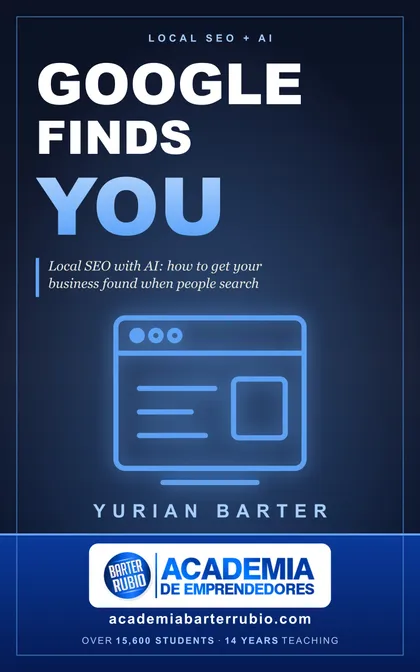
"Google Finds You" in PDF: 17 chapters, each with a challenge. $8.99, delivered to your email.
Get the PDF · $8.99Or learn it free, with a certificate
Start the free Digital Marketing course in the Barter AI Academy app: short lessons, practice with an AI tutor and a certificate when you finish.
Start the free courseFrequently asked questions
Is there a book about structured data for local business?
Yes. "Google Finds You" by Yurian Barter covers it in chapters 6, 9, 3. It is available in PDF for $8.99 and arrives by email.
Can I buy it from United States?
Yes. You pay $8.99 USD with PayPal or a debit or credit card. The PDF is delivered to your email right after the payment.
Is there a free way to learn structured data for local business?
Yes. The Barter AI Academy app has a free Digital Marketing course with a certificate. The book is the deeper, step-by-step version.
More guides from "Google Finds You"
Local SEO Book PDF · Local SEO for Small Business · Google Business Profile Optimization · How to Rank on Google Maps · SEO with AI · Generative Engine Optimization · Title Tag and Meta Description · City Landing Pages for SEO · Website Speed for SEO · Google Reviews Strategy · Google Ads vs SEO · How to Get Recommended By ChatGPT · FAQ Schema and People Also Ask · SEO for Web Designers
More books by Yurian Barter
You Are the Machine · Edit Like a Director · Move the World · Mix Like a Producer · Ads That Sell · Sell Without Pressure · Let Them Find You