Books › Edit Like a Director › 180 Degree Rule in Editing
180 Degree Rule in Editing in South Africa
Readers in South Africa looking for 180 degree rule in editing usually want something practical, not theory. These 3 chapters of "Edit Like a Director" go straight to the point: read the excerpts, try the challenge and decide if you want the whole book.
The Imaginary Axis and Parallel Editing · Chapter 12
There are mistakes the audience can't name, but they feel them. Crossing the axis is one of them.
In this chapter: The Line You Don't Cross · If You Already Shot It and Crossed the Axis · Parallel Editing · The Exercise · The Visible Cause Rule
The Exercise
Take a clip that has two situations and cut it with Scene Edit Detection. First, arrange all the basement shots in order on one track. Then put the kitchen shots on another track, below. With both stories ordered separately, start alternating between them.
Rules for the exercise:
- Respect the order of each story separately.
- Use as many shots as possible.
- Take care of composition, continuity and the axis.
- Change the shot type at every cut.
Tip: if you mess up and scramble everything, hit Ctrl+Z and put them on the second track. Then select them as a block and move them to the right.
Read the full guide to "The Imaginary Axis and Parallel Editing" →
Where the Camera Looks From · Chapter 4
Shot size answers the question "How close?" Camera angle answers a different one: where is the camera looking from? Two videos of the same character, with the same shot size, can tell completely opposite stories just because of the height of the camera.
In this chapter: The Five Angles · The Power of Angle · The Most Important Rule of This Chapter · The Exception That Proves the Rule
The Power of Angle
Try this. Record the same person twice: once with the camera a little below their face, and once with the camera a little above it. Watch both. The first one looks more confident. The second one looks more fragile. The person is the same. What changed was where you put the camera.
Great filmmakers don't move the camera on a whim. They move it because they know what each angle whispers to the viewer.
Read the full guide to "Where the Camera Looks From" →
Linear Editing and Continuity · Chapter 11
And to learn it, there's an exercise almost every teacher uses. We're going to do it together.
In this chapter: The Exercise: Reorder a Scene · The Rule of the Game · The Rules You Need · When Continuity Breaks · The Cutaway Shot: Your Lifesaver · Watch Out for Transitions as a Patch · Heads Up: Overwriting · Review: The Viewer Test
The Rules You Need
You already know the first one: when you change shots, change the shot type. If you start with an extreme wide shot, the next one can't be another one. It can be a full shot, a medium-wide shot, a close-up.
The second is continuity.
There are many kinds: continuity of color, of set, of costume. But today we focus on the most important one: continuity of movement, also called the internal movement of a shot. It's what is happening inside the shot.
The rule: the next shot must relate to the action of the previous one.
If in one shot two women walk toward the camera as if they were about to push something, in the next one we should see how they push someone. If in one shot a woman gets up with a phone in her hand, in the next one she drops the phone, and in the one after that we see it lying on the floor.
Every shot answers the one before it. That is continuity.
Read the full guide to "Linear Editing and Continuity" →
Your challenge for today
Shoot two simultaneous actions, for example, someone waiting in one place and someone approaching from another. Edit by alternating: first long shots, then shorter and shorter ones. Watch how the tension rises as the shots get shorter.
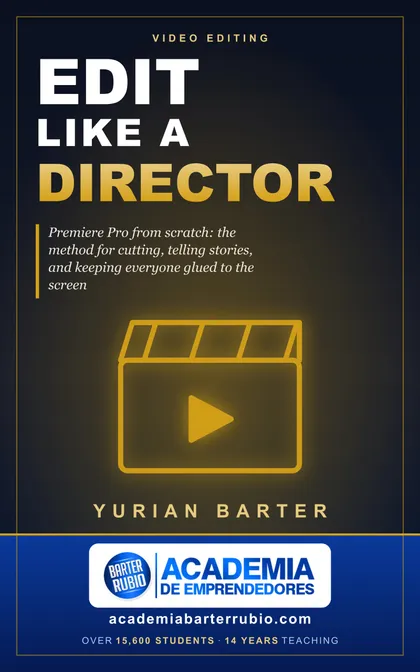
Read the whole book
"Edit Like a Director" in PDF: 17 chapters, each with a challenge. $8.99, delivered to your email (charged in USD; your bank converts it to rand).
Get the PDF · $8.99Or learn it free, with a certificate
Start the free Video Editing and Content Creation course in the Barter AI Academy app: short lessons, practice with an AI tutor and a certificate when you finish.
Start the free courseSee the free Video Editing and Content Creation course in South Africa →
Frequently asked questions
Is there a book about 180 degree rule in editing?
Yes. "Edit Like a Director" by Yurian Barter covers it in chapters 12, 4, 11. It is available in PDF for $8.99 and arrives by email.
Can I buy it from South Africa?
Yes. You pay $8.99 USD with PayPal or a debit or credit card; your bank converts the amount to rand. The PDF is delivered to your email right after the payment.
Is there a free way to learn 180 degree rule in editing?
Yes. The Barter AI Academy app has a free Video Editing and Content Creation course with a certificate. The book is the deeper, step-by-step version.
More guides from "Edit Like a Director"
Video Editing Book PDF · Premiere Pro for Beginners · Premiere Pro Shortcuts · Types of Camera Shots · Video Editing for Beginners · Continuity Editing · Pacing in Video Editing · Keyframes in Premiere Pro · How to Write a Video Script · How to Clean Audio in Premiere Pro · Sound Design for Video · Film Editing Techniques · Composition in Video · Learn Video Editing Step By Step
More books by Yurian Barter
You Are the Machine · Move the World · Mix Like a Producer · Ads That Sell · Google Finds You · Sell Without Pressure · Let Them Find You