Books › Edit Like a Director › Video Editing for Beginners
Video Editing for Beginners in South Africa
If you are searching for video editing for beginners in South Africa, this page gathers the parts of "Edit Like a Director" by Yurian Barter that deal with it directly: 3 chapters, with an excerpt from each and the challenge you can do today.
Editing Is Not the Same as Assembling · Chapter 2
There's a question I ask on the first day of class, and almost nobody answers it right: "What's the difference between editing and assembling?" Almost everyone says, "It's the same thing." And almost everyone is wrong.
In this chapter: Editing: the carpenter's job · Assembling: the storyteller's job · The same footage, two different stories · Edit first, then assemble
Editing: the carpenter's job
Editing is selecting, ordering and layering shots to tell a story. It's choosing which videos you'll use, how long each one will last, where you cut, what you take out and what you keep.
If you have twenty minutes of footage and your final video will run two, editing is deciding which fifteen minutes and fifty seconds have to go. It's hard. It's methodical. It's carpenter's work: measure, cut, sand, fit.
Read the full guide to "Editing Is Not the Same as Assembling" →
Open Premiere Without Fear · Chapter 6
The first time you open Premiere Pro, it feels like they shoved you into an airplane cockpit. Panels everywhere. Buttons with weird symbols. Colored lines. Breathe. All of it has a logic, and in this chapter you're going to understand it.
In this chapter: Where to Install It and How to Get It · Workspaces · Your First Step: Import · Source Monitor and Program Monitor: Don't Mix Them Up · The Moment the Sequence Is Born · A Mistake Everyone Makes Once
Source Monitor and Program Monitor: Don't Mix Them Up
Double-click any clip in the Project panel. A small player opens at the top left. That's the previewer (in the software it appears as "Source").
It's called that because you're viewing the footage before editing: clean, no cuts, no changes. It's your way of looking at "what do I have?"
Now drag that same clip down to the timeline area. Something happens: the timeline comes alive with its tracks, and at the top right, the viewer (the "Program" panel) appears. There you do see what you're editing: with your cuts, your music, your effects.
Remember it like this:
- Previewer (Source): the raw footage.
- Viewer (Program): your edit.
If you change the scale of a video in one, the other doesn't find out. That's why the original footage is always safe.
Read the full guide to "Open Premiere Without Fear" →
Linear Editing and Continuity · Chapter 11
And to learn it, there's an exercise almost every teacher uses. We're going to do it together.
In this chapter: The Exercise: Reorder a Scene · The Rule of the Game · The Rules You Need · When Continuity Breaks · The Cutaway Shot: Your Lifesaver · Watch Out for Transitions as a Patch · Heads Up: Overwriting · Review: The Viewer Test
The Rules You Need
You already know the first one: when you change shots, change the shot type. If you start with an extreme wide shot, the next one can't be another one. It can be a full shot, a medium-wide shot, a close-up.
The second is continuity.
There are many kinds: continuity of color, of set, of costume. But today we focus on the most important one: continuity of movement, also called the internal movement of a shot. It's what is happening inside the shot.
The rule: the next shot must relate to the action of the previous one.
If in one shot two women walk toward the camera as if they were about to push something, in the next one we should see how they push someone. If in one shot a woman gets up with a phone in her hand, in the next one she drops the phone, and in the one after that we see it lying on the floor.
Every shot answers the one before it. That is continuity.
Read the full guide to "Linear Editing and Continuity" →
Your challenge for today
Take the three videos from the previous chapter and write one sentence for each on a sheet of paper: "I want whoever watches this to feel ______." Just one sentence. Then keep it. You'll need it in Chapter 11.
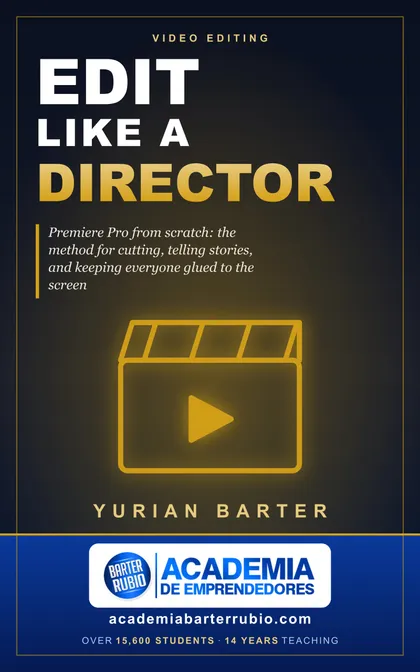
Read the whole book
"Edit Like a Director" in PDF: 17 chapters, each with a challenge. $8.99, delivered to your email (charged in USD; your bank converts it to rand).
Get the PDF · $8.99Or learn it free, with a certificate
Start the free Video Editing and Content Creation course in the Barter AI Academy app: short lessons, practice with an AI tutor and a certificate when you finish.
Start the free courseSee the free Video Editing and Content Creation course in South Africa →
Frequently asked questions
Is there a book about video editing for beginners?
Yes. "Edit Like a Director" by Yurian Barter covers it in chapters 2, 6, 11. It is available in PDF for $8.99 and arrives by email.
Can I buy it from South Africa?
Yes. You pay $8.99 USD with PayPal or a debit or credit card; your bank converts the amount to rand. The PDF is delivered to your email right after the payment.
Is there a free way to learn video editing for beginners?
Yes. The Barter AI Academy app has a free Video Editing and Content Creation course with a certificate. The book is the deeper, step-by-step version.
More guides from "Edit Like a Director"
Video Editing Book PDF · Premiere Pro for Beginners · Premiere Pro Shortcuts · Types of Camera Shots · Continuity Editing · Pacing in Video Editing · Keyframes in Premiere Pro · How to Write a Video Script · How to Clean Audio in Premiere Pro · Sound Design for Video · 180 Degree Rule in Editing · Film Editing Techniques · Composition in Video · Learn Video Editing Step By Step
More books by Yurian Barter
You Are the Machine · Move the World · Mix Like a Producer · Ads That Sell · Google Finds You · Sell Without Pressure · Let Them Find You