Books › Edit Like a Director › How to Write a Video Script
How to Write a Video Script in Australia
Readers in Australia looking for how to write a video script usually want something practical, not theory. These 3 chapters of "Edit Like a Director" go straight to the point: read the excerpts, try the challenge and decide if you want the whole book.
The Technical Script: Write Before You Cut · Chapter 15
Directors don't improvise in the editing room. They show up with a map. That map is called a technical script, and it's the document that turns an idea into concrete shots. With it, you know what to shoot, what to cut, and what's missing.
In this chapter: What a technical script includes · Shot abbreviations · One line per shot · Consistent format · Proofread your text · The script in the editing room
Consistent format
Before you shoot, decide on the aspect ratio: horizontal for YouTube and film, vertical for phones, square for certain formats. If you mix footage in different formats, you'll end up with black bars or cropping in the edit.
Read the full guide to "The Technical Script: Write Before You Cut" →
A Video Is a Very Well-Told Lie · Chapter 1
Look at your phone screen. What you see moving isn't moving. It's a lie. A beautiful, useful, very well-organized lie, but a lie. What's actually there are photographs, one after another, so fast that your brain can't separate them and decides something is moving. And until you understand this, you won't edit well. Because editing is deciding which photographs other people see, in what order, and for how long.
In this chapter: The Story of the Horse · Photograph and Frame: The Same Thing, a Different Place · The Ladder: Frame, Shot, Scene, Sequence · Why Cinema Is the "Seventh Art"
The Story of the Horse
Before photography, if an important family wanted a portrait, they hired a painter. And the painter spent the whole day with them: from morning to night, everyone posing, no one moving. Imagine the patience.
Then photography arrived and everything changed. And then someone noticed something curious: if you put lots of slightly different images one after another, in a short time, human beings perceive movement.
The classic example is a drawing of a running horse. About twelve drawings in one second and, suddenly, the horse is galloping. Nobody animated it. Your brain did the rest of the work.
That's how cinema was born. And here's a date worth remembering: December 28, 1895, in a café in Paris, the Lumière brothers held the first public screening of films. Those first films were a single fixed shot: a still camera recording an action, sometimes for many minutes. A train arriving. People leaving a factory.
Nobody cut. Nobody edited. And nobody yet knew what was coming.
Read the full guide to "A Video Is a Very Well-Told Lie" →
Pacing: Calm or Euphoria · Chapter 13
I'm going to ask you a question that will change the way you watch shows and movies: Why do you feel calm in some scenes and adrenaline in others, when in both of them people are just talking and walking? The answer is in the editing rhythm.
In this chapter: Slow editing · Fast editing · An example to feel it · Color and emotions · Sound · An audio mistake that ruins videos
An audio mistake that ruins videos
A common practice among beginners: mixing two songs at the same time, one in the background and another that was already in the scene. If they're in different keys, meaning they use incompatible notes, they clash and you hear a strange dissonance.
Solutions:
- When the music comes in, lower the volume of whatever was already playing.
- Do a fade-out (let one disappear little by little) while the other comes in.
- Today there are artificial intelligence tools that separate voice and music, and let you keep only what's useful.
Read the full guide to "Pacing: Calm or Euphoria" →
Your challenge for today
Write the technical script for a thirty-second scene with five shots. Use abbreviations. Ask someone to read it and tell you what they picture. If they picture the same thing you do, it's well written.
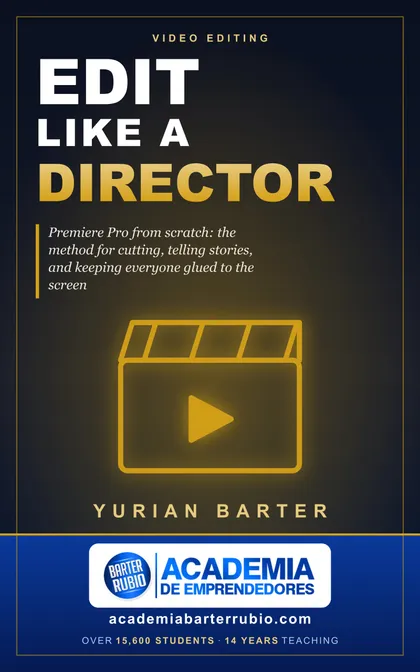
Read the whole book
"Edit Like a Director" in PDF: 17 chapters, each with a challenge. $8.99, delivered to your email (charged in USD; your bank converts it to Australian dollars).
Get the PDF · $8.99Or learn it free, with a certificate
Start the free Video Editing and Content Creation course in the Barter AI Academy app: short lessons, practice with an AI tutor and a certificate when you finish.
Start the free courseSee the free Video Editing and Content Creation course in Australia →
Frequently asked questions
Is there a book about how to write a video script?
Yes. "Edit Like a Director" by Yurian Barter covers it in chapters 15, 1, 13. It is available in PDF for $8.99 and arrives by email.
Can I buy it from Australia?
Yes. You pay $8.99 USD with PayPal or a debit or credit card; your bank converts the amount to Australian dollars. The PDF is delivered to your email right after the payment.
Is there a free way to learn how to write a video script?
Yes. The Barter AI Academy app has a free Video Editing and Content Creation course with a certificate. The book is the deeper, step-by-step version.
More guides from "Edit Like a Director"
Video Editing Book PDF · Premiere Pro for Beginners · Premiere Pro Shortcuts · Types of Camera Shots · Video Editing for Beginners · Continuity Editing · Pacing in Video Editing · Keyframes in Premiere Pro · How to Clean Audio in Premiere Pro · Sound Design for Video · 180 Degree Rule in Editing · Film Editing Techniques · Composition in Video · Learn Video Editing Step By Step
More books by Yurian Barter
You Are the Machine · Move the World · Mix Like a Producer · Ads That Sell · Google Finds You · Sell Without Pressure · Let Them Find You