Books › Edit Like a Director › Pacing in Video Editing
Pacing in Video Editing in Australia
Readers in Australia looking for pacing in video editing usually want something practical, not theory. These 3 chapters of "Edit Like a Director" go straight to the point: read the excerpts, try the challenge and decide if you want the whole book.
Pacing: Calm or Euphoria · Chapter 13
I'm going to ask you a question that will change the way you watch shows and movies: Why do you feel calm in some scenes and adrenaline in others, when in both of them people are just talking and walking? The answer is in the editing rhythm.
In this chapter: Slow editing · Fast editing · An example to feel it · Color and emotions · Sound · An audio mistake that ruins videos
Color and emotions
Take the chance to think about color. In film, the people in charge of art direction and color choose specific colors for specific scenes. Red can mean danger or passion. Green, calm or sickness. It depends on the context. But it's always chosen with intention.
When you edit, do the same: if you want a video to feel cold and techy, the color goes along with it. If you want it warm and familiar, same thing.
Read the full guide to "Pacing: Calm or Euphoria" →
Linear Editing and Continuity · Chapter 11
And to learn it, there's an exercise almost every teacher uses. We're going to do it together.
In this chapter: The Exercise: Reorder a Scene · The Rule of the Game · The Rules You Need · When Continuity Breaks · The Cutaway Shot: Your Lifesaver · Watch Out for Transitions as a Patch · Heads Up: Overwriting · Review: The Viewer Test
The Cutaway Shot: Your Lifesaver
What do you do when two shots don't fit together, but you need to get from one to the other?
You use a cutaway shot: an external shot, from another story or another place, where the characters you just saw don't appear. It works like a breather. The viewer steps out of the situation for a moment, and when they come back, they don't wonder how everything changed.
Example: you want to go from a shot of the young man struggling to another shot of the same young man. In between, you put a shot of a woman who has nothing to do with them, doing something unrelated. Then you go back to the young man. The jump disappears.
Read the full guide to "Linear Editing and Continuity" →
The Imaginary Axis and Parallel Editing · Chapter 12
There are mistakes the audience can't name, but they feel them. Crossing the axis is one of them.
In this chapter: The Line You Don't Cross · If You Already Shot It and Crossed the Axis · Parallel Editing · The Exercise · The Visible Cause Rule
The Line You Don't Cross
Picture two people talking face to face. Draw an imaginary line between them. That line is called the imaginary axis, or axis line.
The rule: all your cameras must stay on the same side of that line. The space where you can move the camera is a semicircle: the 180° range.
Why? Because if you shoot the first person from one side and the second person from the other side of the line, on screen they both look toward the same side, and it seems they aren't talking to each other. The conversation breaks.
Here's an example I like to tell: a woman looks to the left of the frame. Another woman, talking on the phone from somewhere else, looks to the right. Even though they're in different places, when you cut from one to the other, it feels like they're having a conversation. Looking in opposite directions, they "talk" to each other. If both looked to the left, they wouldn't.
Inside that semicircle, you can move freely: draw new lines for each shot, move closer, move farther, change the angle. What you can't do is cross to the other side.
Read the full guide to "The Imaginary Axis and Parallel Editing" →
Your challenge for today
Shoot a simple scene, for example, someone arriving at a house. Edit it twice: one slow (long shots, calm music) and one fast (short cuts, energetic music). Next to each version, write down what it should convey. Show it to someone and ask what they felt.
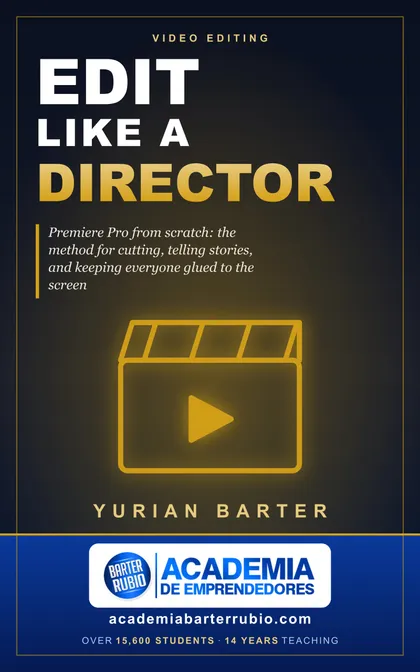
Read the whole book
"Edit Like a Director" in PDF: 17 chapters, each with a challenge. $8.99, delivered to your email (charged in USD; your bank converts it to Australian dollars).
Get the PDF · $8.99Or learn it free, with a certificate
Start the free Video Editing and Content Creation course in the Barter AI Academy app: short lessons, practice with an AI tutor and a certificate when you finish.
Start the free courseSee the free Video Editing and Content Creation course in Australia →
Frequently asked questions
Is there a book about pacing in video editing?
Yes. "Edit Like a Director" by Yurian Barter covers it in chapters 13, 11, 12. It is available in PDF for $8.99 and arrives by email.
Can I buy it from Australia?
Yes. You pay $8.99 USD with PayPal or a debit or credit card; your bank converts the amount to Australian dollars. The PDF is delivered to your email right after the payment.
Is there a free way to learn pacing in video editing?
Yes. The Barter AI Academy app has a free Video Editing and Content Creation course with a certificate. The book is the deeper, step-by-step version.
More guides from "Edit Like a Director"
Video Editing Book PDF · Premiere Pro for Beginners · Premiere Pro Shortcuts · Types of Camera Shots · Video Editing for Beginners · Continuity Editing · Keyframes in Premiere Pro · How to Write a Video Script · How to Clean Audio in Premiere Pro · Sound Design for Video · 180 Degree Rule in Editing · Film Editing Techniques · Composition in Video · Learn Video Editing Step By Step
More books by Yurian Barter
You Are the Machine · Move the World · Mix Like a Producer · Ads That Sell · Google Finds You · Sell Without Pressure · Let Them Find You